Showing posts with label exercise. Show all posts

Tuesday, January 12, 2016

The Peak Health Journey: watching trees grow in a whirlwind

I created a Facebook group, called Peak Health Initiative. It is a group of us who are encouraging and supporting each other on our path to peak health. As I chronicle my journey back from injury and also maintain my health while working through hypothyroidism and fibro, I get bopped on the head by the changes in my body, health, and life.

Here's what's interesting to me about getting in better shape. Things change. Sometimes, it's like watching trees grow, and sometimes it's a whirlwind. Today, I realized my health changes have been like watching trees grow in whirlwind. In other words, some of those changes are happening so slowly that I take no notice until they bop me on the head.

My clothes are fitting more loosely. Until this morning, I kept thinking my dryer must not be drying them as well since usually clothes out of the dryer are tight and then relax as I wear them. But lately, nothing has been tight when I first put it on. Instead of thinking "Hey that must mean I'm getting smaller," I thought, "Hey, my dryer must be malfunctioning." Doh!

So, today, I was outside working/boxing with the standing bag. I am aiming for ten minutes daily before January 20th. I'm up to six minutes. I do fifteen-second intervals of hooks, jabs, crosses, high and low intensity and breaks where I stretch. And when the alarm rang to indicate I was at six minutes, I was surprised and a little disappointed.

"What? I'm done?" was my first thought. On one level, that means I was in the moment and doing my thing. On another level, it means I'm going up to seven minutes tomorrow.

Color me surprised. When I started, five minutes seemed more than I could endure. And this brings me to today's mantra.

"Now matter your current situation, accept where you are right now and then watch how it changes."

What about you? What is your experience of your life and health? How does awareness of your health change as you go?

Sunday, December 23, 2012

Yoga, Thyroid, and the (potential) dangers if you push too far


Today's NYTimes has an article on the dangers of yoga, for men, as written by the man who wrote this year's "Science of Yoga," (who is also a yogi and a writer for the NYTimes). He talks about competitive yoga (sounds like an oxymoron to me) and other ways in which men either push themselves or their instructors push them too hard (btw, he doesn't ignore women in the article, but the focus is men).

When I teach, one of the first things I say to my classes (after we warm up, because, doggone it, I don't believe you can do yoga without being thoroughly warmed up) is that they need to listen to their bodies. If it even feels like it might start *thinking* about hurting, they need to stop and not do it or pull way back to try it safely.

To me, yoga is about being where you are today. It won't be where you were yesterday and it won't be where you will be tomorrow. So, the important thing is to pay attention to what is happening in your body, mind, and spirit right now. If you consistently practice, you will see benefits, and likely, poses that are challenging or impossible to you now will become easier in time. That is the point. Yoga (imo) isn't something to do once a week. It is really something like brushing your teeth. When I get up, I brush my teeth, every single day. That is how I do yoga. Every single day. It's not always an intense hour-long practice. Sometimes, it's five or ten minutes, but I step on the mat, at least for a little while. Every single day.

Being hypothyroid means that I need to do less exercise (very little aerobic because that messes with my thyroid's calm and makes me dip more into hypothyroid land) but I have found that yoga helps me retain balance, strength, and flexibility and even heart health since yes I do raise my heart rate with some of the more challenging poses even if I am not running or jumping to get my aerobics in. Try plank pose on your elbows and toes and try holding it for a minute. (Keep breathing naturally and make sure your elbows are directly below your shoulders. Make sure your butt doesn't rise and that your shoulder blades are broad along your back. Keep your neck aligned with the rest of your spine, your butt flat, and your legs straight so as to not injure yourself. Push your heels toward the back of the room. And remember, if it even feels like it might start thinking about hurting, lower down and rest. Don't overdo. That's not what this is about.) By the end of that minute, you will be very grateful and your heart will be pounding hard.


Even if you do a little but do it every day, you will reap enormous benefits and not just physically. But, pushing yourself can definitely lead to injury so that is the less optimal way to practice. Do it today and tomorrow and the next day and pay attention to what your body is trying to tell you as you sit or stand or lie in a pose and you will be present and eventually by being present, you will progress.

http://www.nytimes.com/2012/12/23/sunday-review/the-perils-of-yoga-for-men.html?_r=0&adxnnl=1&smid=tw-share&pagewanted=2&adxnnlx=1356268466-1IMHsxS8ZQ9G/W5m6rmvTQ 

http://IzoldaT.com

Friday, July 27, 2012

Aside from weight gain and fatigue, depression is one of the most prevalent symptoms of hypothyroidism. Bottom line: if you are hypothyroid, you will tend towards depression. And it's not that you might be predisposed toward depression naturally. It's more that when your thyroid is distressed and is underperforming, depression will often rear its ugly head and bite you on the butt. There is not really anything you can do about it. Even if you normally would never tend toward depression, you will often get depressed if you dip into being an EZH*. Distress and a sluggish thyroid, your slower metabolism, the weight gain, the slowing down of all your bodily functions, all of these things combine to depress you even if depression doesn't normally figure into your world view or your physical symptoms (not to mention the fact that the sluggish thyroid is a depression cause all on its own).

That's kind of what I go through. You see, I'm not normally a depressed person. So, when I first went very hypothyroid, one of the things that I noticed was that everything looked bleak. I found myself being depressed for the first time in my life. What the hell? I thought. Why was I depressed? My life was full. I had a partner I loved. I had good friends. I was doing work I enjoyed. So, what on earth was it that was making me depressed?

When I got the diagnosis, I found out. Since I had hypothyroidism, I was also likely going to be depressed. On top of all the other crap you have to wade through, on top of all the murky fatigue and other symptoms, I was also going to be depressed, perhaps too depressed to do anything at all about the thing that was making me depressed in the first place. So, as I've gotten myself together, and as I started treating the hypothyroidism, one of the things that started happening was the depression reached a manageable level without me needing to address it specifically, at all (this might not hold true for people who tend toward depression naturally).

In fact, one of the clues that tells me that I'm very hypothyroid is I get depressed. When I get depressed, for no reason, I know that I need to check my thyroid. But the tricky thing is that when I get thyroid-depressed, fatigue usually follows closely behind. And if I get it to that point, I might spiral down into the "why bother?" place and that is a bad place to be if you are an EZH. That is hard to come back from.

Normally, I don't feel that things are bleak. In fact, I tend to have a sunny disposition. I tend to want things to work out. I tend to hope that they're going to work out. But when the hypothyroidism grabs me by the throat, I don't think things will work out and I sink into depression. And here's the sneakiest part of all: if I'm all stressed out, the depression gets worse. That's one of the funny things about being hypothyroid. Hypothyroidism is supposed to make you tend toward depression. Hyperthyroidism (an overactive thyroid) is supposed to make you tend towards anxiety. But, if you're under stress and hypothyroid, then you might achieve that most egregious of double whammies: both anxiety and depression.

So, how do you deal with it? How do you handle your depression if it's coming on because of hypothyroidism? The trouble here is it's a double-edged sword. Your depression makes you feel that it's too much work to fix anything at all (and that it probably won't work so why bother trying)?  The hypothyroidism makes you so tired that it's almost not worth it to push out of bed and do the things you need to do, the things that you must do, in order to make yourself better. There have been times in my life when I basically turned myself inside out trying to maintain my life and when depression compounded the trouble, it became practically impossible to fix.

Nowadays, I try to take it easier on myself. I try to catch things early. I do daily check-ins. First thing in the morning, I ask myself how I feel. Here are some of the questions I try to answer:
  1. Am I fatigued? (More often than not, yes)
    1. What can I do about it? Sleep? Maybe. Exercise? Only a little.
  2. Am I aching? (Ditto)
    1. What can I do about it? Yoga, ultrasound, massage, bath, or passionflower supplement (before bed).
  3. What is my outlook for the day? 
    1. Open ended answer but it often depends on what my deadlines are for the day.
  4. Do I feel stressed out? (Often, yes, though I try to mitigate the stress with my daily yoga practice.)
    1. What can I do about it? Breathe. Breathe. Breathe (at least five, deep, full breaths before I do anything else). Yoga or Tai Chi. Reach out to a friend or my husband. Do something I enjoy even if it is only for a few minutes before I jump into my day. 
  5. Do I feel anxious? (Again, this depends on the deadlines for the day)
    1. What can I do about it? This one depends on the time of year. A cup of hot tea (no caffeine) will often have a soothing effect. I go for a hike with the dog and focus on the things I see in nature. And breathe breathe breathe. Taking full, deep breaths is one of the best ways I've found to handle anxiety if it comes up as part of my hypothyroidism. We'll talk more about how to breathe in the next post.
  6. Do I feel sad? (If the answer to this one is "yes," I start looking at other indicators that I might be in thyroid-depression. This is because I'm not generally prone to sorrow.)
    1. What can I do about it? This one often necessitates an increase in kelp in my life (the iodine in kelp helps in thyroid hormone production). Then, I try to do something I enjoy even for a minutes. For example, I play one of my favorite songs to dance to and I go crazy dancing. I move my body, even for a little bit. It helps break through the layer of sorrow very nicely. 
  7. Do I feel depressed? (If this one is a "yes" well then, I need to be ready to try to deal with it.)
    1. The answer to this one is similar to the one for sadness. I know I need to look at my TSH level if the depression persists for any length of time. So, in addition to trying to mitigate the depression, I will get my TSH levels tested. Here's a place where you can order and conduct the test online (not sure if you then have to have your doctor read the results, since I've not used this particular company before). http://www.healthhometest.com/product_info.php?products_id=38
There are more things to be done. And next time, I'll list more possible ways to combat depression. First on the list: Breathe. We'll talk more about how to breathe to get the most out of your breathing apparatus. Please note: I am not telling anyone to not see their medical professionals to treat their depression. This is a blog on treating the issues naturally so the topics of medication will not be addressed here.

Until next time, Izolda. http://izolda.info
If you liked this post, please consider sharing it or "liking" it, or tweeting about it. Cheers!

*EZH=Exhausted Zombie Hypothyroidic

Tuesday, July 17, 2012

Hypothyroidism Treatment Requires Permanent Lifestyle Changes

Treating hypothyroidism is like being on a maniacal roller coaster ride. When you're doing well, you have energy and can even fly pretty fast and loose. When you aren't doing well, life feels like it's taken a jello-filled body suit that weights three hundred pounds, forced you to wear it and still try to run marathons on a regular basis. In other words, it crushes you.

In my own process of treating it, things ebbed and flowed. For a little while, I was okay. When I wasn't, I thought I might turn inside out from the fatigue. At my lowest ebb, I ended up with an 83 TSH count (remember, normal is somewhere between .3 and ~4.5). I remember I was so exhausted that I barely made it in to see Dr. L, the Endocrinologist. She had advised me strongly that I needed to go on meds the first time she diagnosed me and at that point, my TSH level was a 14. So, when she saw 83, she was incredulous.

"How are you up and about?" she asked.
"What do you mean?" I replied.
"An 83 TSH count means you should be having trouble getting out of bed."
"Well," I was getting a bit nervous now. "Actually, I've been very busy. I've been doing a lot of running around."

Then, she said something that completely freaked me out. "With an 83 TSH count, you ought to be in a coma. Nobody walks around and does anything with this much Thyroid Stimulating Hormone in their system. This could get worse and very quickly. Your bodily systems could all shut down. You need meds. Right now."

"I still don't want to do that."

"At least, you can go on them for a few months to give your thyroid a break. Or it will burn out. You will have nothing left and you don't want to get to that point."

It's hard to describe how freaked out I was. I was barely hanging on, as it was. Moving through my days was taking every single iota of effort I could eke out of my exhausted body. The tiniest little thing took everything I had to give. And I had little left. So, I decided to trust her and try the meds.

"So, what you're saying is, I can go on them for a little while and then stop?"

"It's highly irregular, but yes, you can do that. You can wean yourself off them when your thyroid has had a rest."

"Okay," I agreed. "I'll do it."

I went on Synthroid for three months. I weaned myself off and here's why. Nothing changed. I had no more energy than I had had before. I didn't lose weight. My metabolism stayed the same as it had been. With the exception of the fact that I guess my thyroid got a little break, everything else was completely the same as it had been when I wasn't on the meds. So, my body had enough thyroid hormone, but nothing else changed. I decided that I might as well feel like crap without the meds since I still felt like the exact same form of crap with them.

It turns out that my form of hypothyroidism is the kind where my thyroid is making (just) enough Thyroid Hormone, but it's very inefficient. It's working too hard to make it. So, the pituitary gland was doing its job and pumping out more TSH to keep my thyroid on task. And the inefficiency spiral went on and on.

So, even going on the meds, made no difference in my life. What did make a difference? Grabbing my life by the balls made a difference. I had to step away from the "tie-myself-into-knots" life I had been leading. The "I work best under pressure" paradigm had to shift or I was going to burn myself to a crisp. I had to bring balance back into my life or I could have died. Here's another insidious thing about this seemingly innocuous little gland. It governs so many aspects of our bodies that we would be shocked at just how much it controls.

Here is the webmd article on the thyroid, its functions, diseases, and issues. I took this entire situation to mean that I needed to change my life. I obviously couldn't keep going the way I had been. It was impossible to sustain. So, I stepped back and changed.

In my early 20s, I'd been working a job (that I loved) but I was working 14-hour days seven days a week. I started having pains in my gut. When I finally went to the doctor, she told me that I was developing an ulcer and that if I didn't de-stress, I would be in deep trouble. I changed my ways. I stopped working so much. I took care of it and the ulcer never fully developed.

The same had to happen now. Maintaining the level of stress and activity in my life would lead to permanent shut-down. So, I walked away from much of my busy life and started on a different path. Here's the thing: for the most part, I loved and still love the vast majority of the activities that make me so busy. I could list all the things I do/have done but I will spare you the details. Suffice it to say, there are and have been plenty. But, in order to chill out, I needed to get a grip and make some choices. And then, I had to stick to them. Forever. If I didn't, I'd keep riding the same roller coaster indefinitely.

And that's the crux. These changes that need to be made aren't temporary. They aren't about temptation and willpower. You can't just resist the temptations. You need to make a permanent lifestyle change. You cannot maintain good thyroid health naturally if you are still engaged in the activities and habits that kicked your thyroid's ass to begin with.  It will not work.

In my personal tale, allow me to talk about bread. I should. not. eat. bread. Period. For whatever reason, it exacerbates my drop into the fatigue hellhole. Bread exhausts me and enough of it slams me into sleep. Sometimes, the only way I stay awake is to literally slap my own face. It's not a good way to go, for me. And yet. And yet. I still go back to eating it and have done so periodically over the last fifteen years. I love bread. I really love it and once I have that one little piece, I start making excuses for myself about why I should have the next one tomorrow. Before I know it, the yoyo cycle of quick energy boost/fatigue hellhole has run amok again. And it can take weeks or months for me to get off that particular merry-go-round. Right now, I'm off bread and have been for the last five months. I feel great! But, and this is a big but, I have to remain vigilant about what I put in my body because even the tiniest crumb will start me down the cycle. Ideally, I want to become one of those people who just doesn't eat bread. I have done that with chocolate (which I love but which I have to avoid). I haven't had chocolate in three and a half years. Every once in a while I still miss it, but it's nowhere near how much I craved it before I gave it up. Potatoes are another temptation. they sing their crispy or buttery siren song and I am lost. But I am trying, hard, to be the kind of person who just doesn't eat them. That one might just take the rest of my life to attain, but I will not give up on myself. My health is too important to do that.

So, the big decision needs to be made by you. Am I going to change my life? Can I stick with the changes that are necessary? If the answers are Yes, then go to it. If not, then I would suggest you take the time to assess and evaluate your options. This method works if you work it, but only if you work it daily and permanently.

Do you have foods/habits/activities that exhaust you? What are they? How do you handle your fatigue?

As always, if you have questions, please ask. I will either answer them or try to point you in the right direction.
---
Until next time, Izolda. http://izolda.info


Thursday, July 12, 2012

Weight gain. Yep, I worried about it. I started getting heavy in my teens (right around when I likely became hypothyroid. Coincidence? Don't think so). I worked out. I tried to eat well. I did all the stuff you're supposed to do to stay in shape. In my early 20s, I became a vegetarian, I regularly did aerobics. I rode my bike. You get the picture.

But still the weight piled on like I was secretly eating four slices of cheesecake a night. And no matter what I did, I could not get the weight to come back off. When I got diagnosed with the hypothyroidism (I just realized I wrote it like it's a major epidemic like, The Plague, or the Black Death and heck maybe it is), it started to make sense. It wasn't my fault the weight had piled on. My thyroid was sluggish and the weight gain was one of the major symptoms. My metabolic rate firmly sat in the toilet and refused to budge. And exercising and eating healthfully made no difference whatsoever. (And the heavy exercising made things worse by taxing my already distressed thyroid.)

Now that I knew what the problem was, I was faced with a decision. Meds or no meds (oh and another thing they don't tell you: even if you go on meds, that doesn't mean that you will lose any weight at all. And you know, if you have read any other posts here, that I chose the non-meds method.)

You have to understand, the weight gain wasn't the main reason I finally went to the doctor to figure out what the problem was (the lack of energy and a menstrual cycle that wouldn't turn off was what did me in), but it was up there. I didn't like that my body hurt. I hated some of my other symptoms, but the weight gain and the accompanying issues pressed on me as if I was doing something wrong by not taking the weight off.

That's the thing, I think. Somehow, I felt guilty for not being effective enough in my effort to control my weight and my body. To top it off, as I gained more weight, people started commenting on my appearance. "Lose some weight!" or "Why don't you get some exercise?" were just two of the milder things I heard in the street from complete strangers (of course any friend that said something like that to me would stop being a friend immediately, but that's another story). The people who took it upon themselves to "advise" me on my weight/health/appearance had no idea about my efforts to maintain or lose weight. The only thing they saw was a fat girl/woman and for some bizarre reason they felt it was within their purview to harass me about it (sometimes under the guise of "caring." One particular woman said, "You're so pretty. If only you would lose some weight.")

I am sure there are some people out there who would like nothing better than to lie around, eat cheesecake and gain weight. I am sure there are people out there who are perfectly happy with their weight (no matter their size) and who don't give a da*n about the fact that they are fat. And I'd love it if we lived in a world where people of different sizes were just that, people of different sizes. And no one would say jack to them about it. But the perception persists that if you are fat or heavy that you are only that way because you don't care enough to get off your fat butt and do something about it (and that they get to talk to you about it). Is that perception appropriate? No. Is it still prevalent? You bet.

The idea that I didn't/don't care about my health and my weight, is patently untrue. I tried. I tried, hard, to lose the weight, but with hypothyroidism, it wasn't going to happen. So, I have had to deal with the lack of energy in combination with weighing more. And here's the thing, when you weigh more, it takes even more energy/effort to do the simplest things. So, it's a double-edged sword. Not only does the hypothyroidism make you gain weight, but you also have no energy, and then because you are heavier, it takes even more of that already scant energy to accomplish just about any task. It's enough to make you want to tear your hair out. Oh wait, the hypothyroidism takes care of hair loss for you, because, yes, that's another symptom.

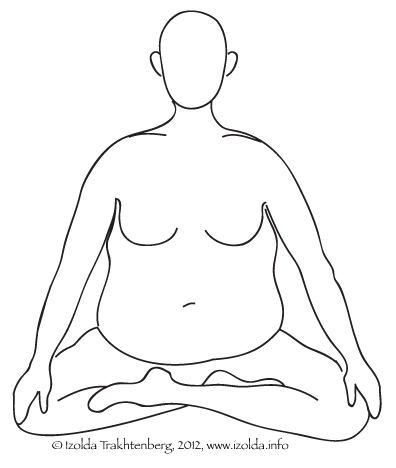
Here's an image of a typical hypothyroidic.
This body shape often characterizes people with hypothyroidism. Often, the person will be barrel-shaped with smaller arms and legs but with a big, rounded torso. The upper abdomen will sometimes protrude further than than the lower.

We tend to carry our weight in the middle. Often, the upper part of the belly is big while other parts of the body are well within what would be considered a normal range by the CDC. They say that the stress hormone, Cortisol can be responsible for fat that gets stored in the middle of the upper belly. (Here is more information on Cortisol: http://www.webmd.com/a-to-z-guides/cortisol-14668 and here is information on Cortisol and belly fat: http://www.webmd.com/balance/stress-management/stress-body-shape?page=3). This is the way I am shaped as well. Because of this, I have been asked many times when I'm due, as if I am pregnant. It's quite shocking really that people don't realize that this isn't something they ought to be asking about.

For some reason, a person's weight (or reproductive status) seems to still be a subject up for discussion.  It boggles my mind.

Regardless, what can we EZH* do about the weight gain? There are things. First and foremost, get more sleep. I don't care what you have to do. Figure out a way to get more shut-eye. First, it will help you relax and release some of the burden on your thyroid. Second, it will give your body a chance to repair itself. Third, fourth, fifth ... there are lots of reasons. It might sound counterintuitive but it's so very true. So, get more sleep.

Second, keep your exercise consistent but minimal. That means no major heart-blasting super nuclear aerobics that blow the top off your head. The most important thing you can do for your thyroid and your metabolic rate is to give it time to recharge. Big, explosive exercise will kick your metabolic rate's butt straight into that commode from above. Do a little bit of exercise every day and consider doing whatever exercise will make you calm. Raise your heart rate a little but not too much. (More on all this at a later time.)

Third, regarding your food intake. Oh boy does it matter what you eat! EZHs tend to crave fast carbs and sugar. I think we do that because we desperately need energy, at all times. It is crucial that you stop eating white sugar (and all sugar, if you can). It fools your body into thinking you have more energy than you do. Don't trust the energy you get from it. It's pulling its sucrose-y wool over your eyes. Here's another counter-intuitive idea. Eat slower foods, in general. Instead of white rice, eat brown rice. Instead of white bread, try not to eat any bread and if you must, make it the really crunchy whole grain stuff. It will take longer to digest but it will give you better long-term energy. No, it won't be the quick fix, but the quick fix just leaves you desperately burning for more quick-fixes.

And that's the crux of it. Dealing with my thyroid issues naturally is a long-term proposition. There is no quick fix. Even meds won't be a quick fix. It takes consistent, daily work. I find that it's taken a daily commitment to myself. It takes me away from other things I could be doing, but it's worth it. The changes in my exercise regimen, awareness of what and how I eat, sleep patterns, and stress levels have raised my energy, brought the weight down, and gotten me *this* close to normal range. Oh how I will celebrate when I get there.

Until next time. Izolda http://IzoldaT.com

*Exhausted Zombie Hypothyroidics

Tuesday, July 10, 2012

Stress: the Thyroid's Enemy #1

Stress! It kicks all our butts. They've done studies about which countries are the most stressed out and hey the USA is close to the top of the pack (I'm shocked. Shocked, I say! Not.). Here are some numbers from the Expat Channel. A list of the four most stressful locations to move to: South Africa, USA, Australia, Southern Cyprus. According to Forbes, the most stressed out cities in the USA won't surprise us: They are (in order): Los Angeles, New York, Chicago and Washington, DC. There are also studies on the most stressful jobs. 

People are out there studying stress because let's face it, it's a killer. (In case you need more proof, here's a list of scholarly work on stress and heart disease. I know I could find other ways in which stress kills, but I'm sure you get the point.) Here's an American Psychological Association study that links stress directly with depression and obesity. "And respondents who reported higher levels of stress were more likely to be obese or suffering from depression." (This is from a yahoo article about the study.) Another shocker: stress leaves you depressed and makes you gain weight.

Here's the thing: Two of the most prominent symptoms of hypothyroidism: (unexplained) weight gain and depression. So far, no studies have confirmed the direct link between stress and hypothyroidism. But, I'm here to tell you that I think it just hasn't been discovered yet. In my personal tale, the only time I ever go deeply hypothyroid is during stressful times in my life. At my most stressed out, my TSH level hit an all-time high 83 (remember normal range is somewhere around 0.1-~4.5).

I believe stress kicks the butts of people with the potential to become hypothyroid straight into the desolate land of the Exhausted, Zombie Hypothyroidics (yes, I know it's not a real word, and no I don't care, because I've written "people with hypothyroidism" way too many times already. In fact, I think from here on in, I will refer to us as EZHs.)

EZHs tend to gain weight easily and they have a hard time taking it off regardless of their exercise level or healthy eating habits. In my opinion, a lot of exercise (depending on the type you choose to do), will lower a EZH's metabolic rate even further. That will lead to less energy and more weight gain. Talk about irony... So, even when you do all the right things, if you are a EZH, you might just be making yourself worse, rather than better.

For example, they say that we should get 30 minutes of moderate-intensity aerobic exercise five times a week for optimal health (Here's the CDC list of recommendations on that). Or they want an hour and 15 minutes of vigorous-intensity exercise a week. But, and this is a big "but," intense aerobic exercise when the thyroid is already sluggish, makes the thyroid go into a tale spin (at least it does to mine and I don't know about studies on that so this is my opinion, here). Depending on what's causing your pituitary to pump out TSH (testing for Thyroid Stimulating Hormone [TSH] levels is the usual way medical professionals first test you for hypothyroidism and often what the diagnosis is then based on), you could be doing yourself damage by keeping up with a lot of exercise if you are an EZH. 

What's good for the goose, isn't necessarily good for the gander, here. EZHs need to look at what they are doing to raise their heart rate extremely carefully. Yes, we all need to exercise our hearts and our entire cardiovascular systems. No question. But, EZHs need to monitor themselves and not do too much (and that is going to be based on the individual) because I believe they will knock themselves further down the EZH Hole of Doom.

The same goes for the food we eat. We are told: eat dark, leafy greens. Yes! Let's do that. Let's eat lots of spinach. If you are an EZH, however, you need to watch your spinach intake. Spinach is a goitrogen. It contains substances that interfere with the production of thyroid hormones. Read more on foods to eat or not to eat, here. So, while regular people can and ought to eat spinach, EZHs might want to be wary of it. And the same can be said for other foods that regular people can and ought to eat. More on that later.

So, when EZHs are stressed or have gained weight or are depressed, we might reach out to exercise to help with that. We might start eating those dark, leafy greens. After all, that's what we're told to do. But, those very things can make things worse for us. So, then, we need to figure out what we can do.

First and foremost, Deal. With. The Stress. Alleviate what you can and try to handle what you can't. And breathe. Keep coming back to your breath when you start to feel like you are in that never ending loop of craptastic stress. Your breath can calm you down and get your nerves and stress levels under control. So, next time you find yourself in that "Crap! I'm perpetually reenacting the Luke Skywalker/Darth Vader fight scene from the end of "The Empire Strikes Back," (You know. It's the one where Vader tosses too many things at Luke and Luke just ends up flailing and failing.) just stop and take three, full, deep breaths. Stand or sit still for a minute and just breathe. You will feel a trickle of your own power and (dare I say it) sanity, return. That will alleviate some of the immediate pressure on your thyroid and your adrenals and that will help you take the reins again more calmly. Then, you can take this opportunity to take a stand for your own health, to lay claim to your own well being.

Take the power into your own hands to look at what you and your body need. It's incredibly empowering and can also be really frightening to stand up and take our own health in hand. I'm not saying ignore your medical professionals. I'm saying work with them. I'm saying educate yourself on the literature. I'm saying check in, really check in with your body. No one, and I mean no one, knows your body better than you. You live in it every day and you know your aches, your pains, your issues, your victories, your everything better than anyone else on the planet can possibly know. The thing is that sometimes, exactly because we live only in our own bodies, we start accepting our aches, pains, and issues as normal. This is my life, we might think, and this pain/pressure/fatigue, etc. is just how it is. 

Maybe other people experience it the same way and maybe they don't, but it doesn't matter. Your pain is your pain and your thyroid is your thyroid and ultimately, the person responsible for the state of your health is you. The doctors, the medical professionals, physical therapists, nurses, acupuncturists, faith healers, whatever - they can tell you the diagnosis, they can prescribe the meds, they can lay out your options, they can suggest what you should do. They can even tell you strongly. But ultimately, the decision on whether or not to follow the advice, take the meds, go on the regimen, get the treatment, stop eating high-fat food, stop eating sugar, start eating carrots, start exercising, read up on your condition, or do none of the above? It rests with you.

So what to do? I'm going to ask you to sit down, right now, and make a list. Write down the things that you enjoy doing, the things that relax you. Are they: reading? Walking? Listening to or making music? Seeing a movie? Meditating? Write them all down. Make the list as comprehensive as you can. Write down anything you can think of that makes you feel peaceful and relaxed. 

Are watching television, surfing the internet, or drinking alcohol on the list? If so, those are the three biggies, I would advise against doing. They all get you out of your body and what you need to do when trying to do things naturally is be absolutely in your body so you can note and acknowledge (and perhaps act on) your status and any changes. (If you want to share some of your relaxation activities, please comment here and let me know. I'd love to see them.)

Once you have your list, start choosing one or perhaps two to do every day. Do only what you can. Remember, you don't ever want to put unnecessary pressure on yourself or your thyroid. Take it slowly. Start small. If you only spend two minutes dancing like a crazed marionette in your living room (one of my relaxing rituals), you will reap incredible benefits by opening the steam valve, even a little. (More on opening the steam valve at later date.) Do the things that will help you relax and remove some of the stress on your thyroid. It will thank you. Mine has thanked me by coming down to a TSH level of only 4.79. I am this close, .04, from being in the normal range. And I'm going to keep working on getting it completely back to being smack dab in the middle of that range. It's more work but it's worth it.

http://IzoldaT.com

Please Note

Welcome to Natural Thyroid. This blog details my process of treating my hypothyroidism naturally. Please note: I am not telling you *to* do or not to do anything with my posts (remember to work with your medical practitioner, whether it's an allopath or an alternative medicine practitioner).